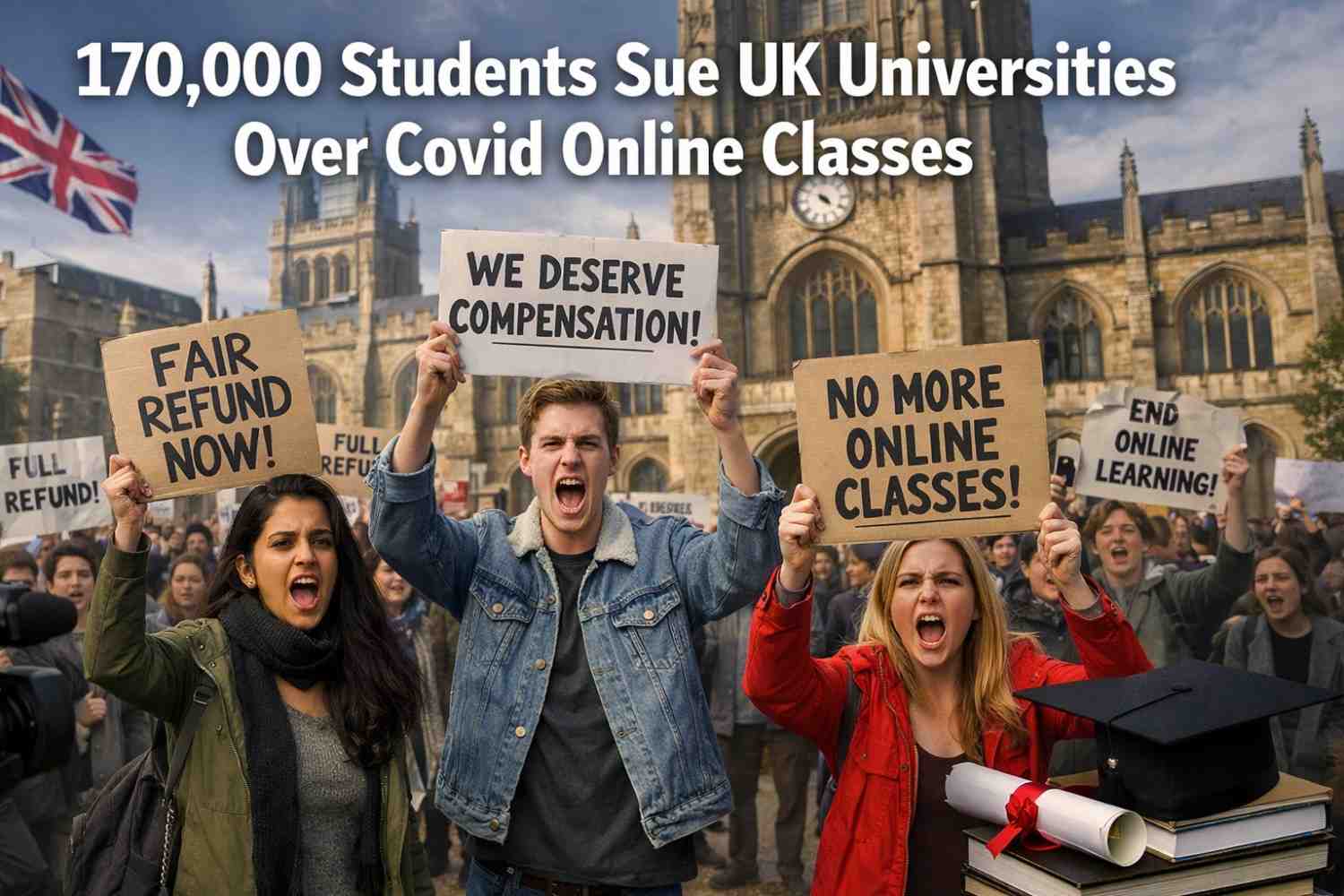
More than 170,000 current and former students are preparing legal action against 36 UK universities, arguing that the education they received during the Covid-19 pandemic did not match what they paid for.
The move follows a recent settlement between University College London (UCL) and a group known as the Student Group Claim. While the details of that agreement remain confidential, it appears to have encouraged thousands of other students to pursue similar claims against institutions across the country.
Lawyers representing the students have sent formal pre-action letters to 36 universities. These letters outline the intention to seek compensation for what students describe as a significant gap between the in-person university experience they were promised and the largely online teaching they received during lockdown periods.
The universities named include institutions such as the University of Bristol, University of Birmingham, University of Leeds, University of Liverpool, Newcastle University, University of Warwick, University of York and several others across England and Wales.
The Core of the Legal Argument
At the heart of the claim is a consumer law argument. Students paid full tuition fees—often £9,250 per year—expecting face-to-face lectures, access to campus facilities, laboratories, libraries, and the wider student experience. Instead, much of the teaching moved online for extended periods, particularly during the 2019-20, 2020-21 and 2021-22 academic years.
According to Shimon Goldwater, a partner at Asserson Solicitors, the issue is straightforward in legal terms. If a consumer pays for one level of service and receives something substantially different, compensation may be justified. The legal team argues that universities should not be able to rely entirely on contractual clauses that limit responsibility for events outside their control.
The focus of many of the new claims is the difference in value between in-person and online delivery. Economic analysis is expected to play a major role in determining whether students paid more than the education they received was worth under pandemic conditions.
Universities’ Position
Universities UK, the body representing more than 140 higher education institutions, has defended the sector’s response. A spokesperson described the pandemic as an “unprecedented challenge,” noting that universities were legally prevented from offering normal in-person teaching during parts of lockdown.
Institutions, they argue, adapted rapidly to remote learning in order to ensure students could complete their degrees. The government at the time made clear that universities were responsible for setting their own fees but were expected to continue delivering high-quality education.
UCL has not admitted liability in its settlement with students, and neither side has disclosed the financial details of that agreement.
Student Frustration
For many students, the dispute is not just about money but about experience.
During lockdowns, students were often sent home or confined to university accommodation. Access to shared facilities—studios, labs, performance spaces and specialist equipment—was restricted. Those studying fine art, applied arts, engineering, or laboratory-based subjects felt particularly disadvantaged.
Graduation ceremonies were cancelled or moved online. Social life was limited. Many students felt they lost a once-in-a-lifetime opportunity to build friendships and networks.
Georgia Johnson, who joined the Student Group Claim, studied at the University of Manchester before beginning a Postgraduate Certificate in Education (PGCE) in 2020. She says that while her undergraduate experience felt supportive, her teacher training year during the pandemic was deeply challenging.
Large parts of her PGCE were delivered via Zoom or in limited school “bubbles.” She describes the experience as frustrating and says it left her feeling unprepared when she qualified in 2022. Rather than stepping straight into a teaching role, she worked as a teaching assistant at a lower salary while building confidence.
“I just felt really let down,” she says, reflecting on the financial and emotional investment she made in her course.
The University of Manchester declined to comment on her specific case, referring instead to the broader statement from Universities UK about adapting to difficult circumstances.
Wider Disruption
Beyond Covid restrictions, many of the affected students also experienced repeated staff strikes over pay, pensions and working conditions. These industrial disputes led to cancelled lectures, delayed assessments and reduced contact hours in some institutions.
Pre-action letters seen by the BBC state that students suffered “disappointment and distress” alongside any financial loss. Claims relate primarily to academic years 2019-20, 2020-21 and 2021-22, although hybrid teaching continued in some courses into 2022-23.
What Happens Next?
The deadline for bringing Covid-related student claims is September 2026. That gives current and former students limited time to decide whether to join collective legal action.
If cases proceed to court, the outcomes could have significant implications for the UK university sector. The dispute raises complex questions about contractual obligations, consumer rights and how institutions should respond in extraordinary circumstances.
For students involved, the case is about more than refunds. It reflects a broader sense that the pandemic disrupted not just their lectures, but an important chapter of their lives.
FAQS
Q1. What is the UK universities student lawsuit?
It is a legal action where students are seeking compensation for online teaching during Covid.
Q2. How many students are involved?
Around 170,000 current and former students are part of the UK universities student lawsuit.
Q3. Why are students asking for compensation?
They paid full fees but did not receive in-person education.
Q4. Which academic years are included?
2019-20, 2020-21 and 2021-22.
Q5. What is the deadline to file claims?
September 2026.